
DXC × Fable · Case study
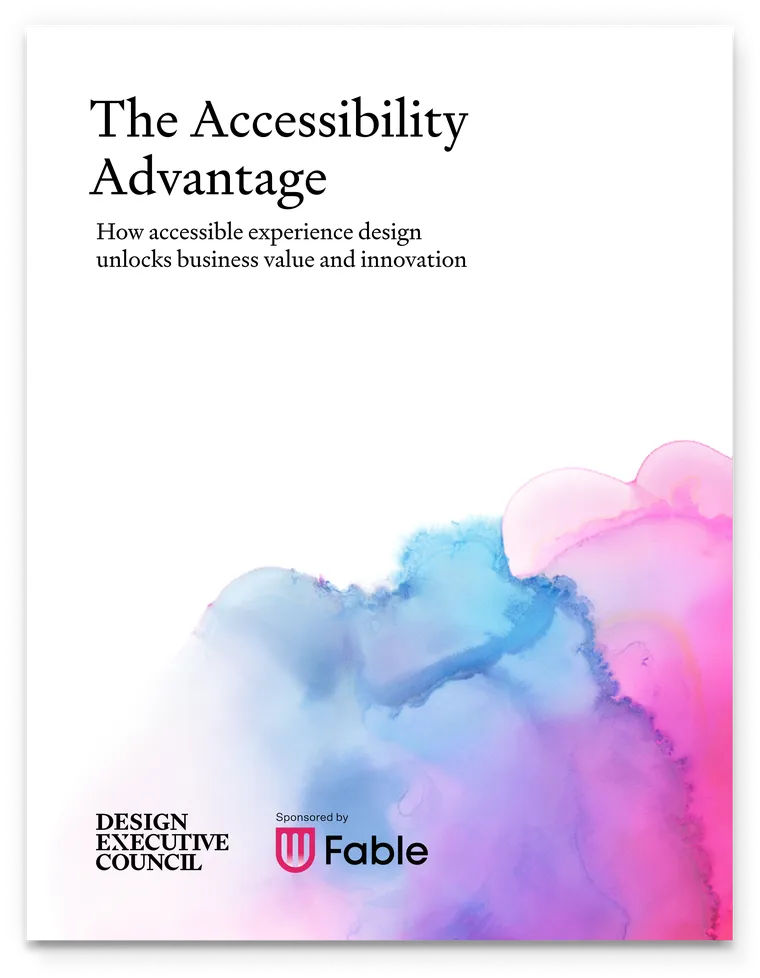
The Accessibility Advantage
Most design leaders already believe accessibility is the right thing to do. The harder problem has been proving it pays and getting the organization to fund it like it does.
A sponsored executive report that moved accessibility from a compliance obligation to a growth strategy, and made the case for why it's the foundation any organization needs before scaling AI-driven experiences. Anchored in case studies from U.S. Bank, Warner Music Group, Target, and The Cigna Group — four global enterprises in regulated, complex industries.
Senior design & accessibility leaders interviewed, including Chief Design Officers, VPs, and Directors of Accessibility Programs
Global enterprises, spanning banking, music, retail, and health services, from roughly $5B to $270B in revenue
Featured leaders who returned for the public panel
Problem
For years, accessibility lived on the compliance checklist: a box to clear, owned by a small specialist team, justified mostly by legal risk. Design leaders rarely disputed it mattered, but lacked the language to argue for it in business terms like revenue, market reach, cost, and product quality.
AI made the gap urgent. New technology builds on the experiences already in place, and organizations that hadn't made the business case for accessibility were about to scale new products on a weaker foundation than they realized.
Research questions
Following four questions did the heaviest lifting and were chosen to move the conversation from compliance toward business performance:
- Where do design leaders stand in the shift from accessibility as compliance to accessibility as a strategic capability?
- What is the cost of investing in accessibility late versus early in the product lifecycle?
- How do design leaders scale a centralized accessibility practice into one with distributed team ownership?
- What safeguards must leaders establish to ensure AI supports — rather than undermines — accessibility?
A 60-minute interview guide translated these into five parts—strategic value, regulation and risk, funding and justification, maturity, and a closing reflection—written to surface stories and decisions rather than restate statistics already in the market.
Approach
The research paired a senior design leader with their accessibility lead at each of four enterprises: U.S. Bank, Warner Music Group, Target, and The Cigna Group. Each case study captured both the executive's strategic framing and the practitioner's operating reality.
What I led
- 01
Research foundation. Built the secondary research base that gave the report its POV — mapping how accessibility is currently framed across the industry, where existing research is concentrated, and what statistics could credibly anchor a business case for senior leaders.
- 02
Interview guide. Authored the guide from that foundation, structuring conversations to draw out strategic framing and operating reality side by side from each enterprise.
- 03
Interview synthesis. Led the synthesis pass across four executive interviews. The recurring patterns from that analysis shaped the five dimensions of business value the report was built around.
- 04
Co-authorship. Co-authored the report end-to-end with DXC's and Fable's editorial teams, including the reframe from compliance to business foundation that the report led with.
- 05
Launch activation. Designed and produced the public, co-branded panel that extended the report into a live executive conversation — recruitment, discussion guide, speaker prep, and post-session synthesis.
Reframe
The most consequential move the report made wasn't a new operating model — it was a new definition.
Designing only for a best-case user ignores how people actually use products. The report reframed accessibility around three kinds of human variability: permanent conditions like blindness, temporary ones like a broken arm, and situational ones like low light or holding a baby. A constant condition of real-world use, rather than a niche.
From the research
One in four U.S. adults lives with a disability and the same design choices benefit the other three, from new parents to people balancing an armful of groceries.
Research findings
The program's payoff clustered into five dimensions — what leaders used to drive adoption and defend budget.
- 01
Revenue growth and market expansion
Accessibility unlocks underserved segments and new market opportunities.
- 02
Improved customer experience, innovation and loyalty
Accessible design improves usability and trust for every customer.
- 03
Operational efficiency, cost and risk reduction
Embedding accessibility upstream prevents costly fixes and legal exposure later.
- 04
Product quality and consistency at scale
Design systems and shared standards deliver reliable experiences across global portfolios.
- 05
Readiness for AI and emerging technologies
Strong accessibility foundations let AI features improve usability rather than amplify barriers.
From the research
U.S. Bank found that fixing an accessibility issue in design or testing costs three to four times less than fixing the same issue in production.
And one pattern held across all of them: the most mature programs had made the same shift from a single central team policing compliance to ownership distributed across the organization—through Centers of Excellence, embedded champions, and train-the-trainer education that multiplies a small team's reach.
From the research
The Cigna Group has scaled accessibility across a global workforce on a Center of Excellence model that has been in place for nearly a decade.
These findings resolved into seven concrete recommendations for leaders, from moving accessibility upstream to integrating it into AI development.
Recommendations for leaders
The findings resolved into seven recommendations. Three carried the most weight for senior leaders:
- 01
Move accessibility upstream.
Integrate accessibility into discovery and product development, not just QA. Early alignment reduces rework and improves the user experience.
- 02
Secure buy-in by linking accessibility to business performance.
Align accessibility goals with revenue targets, customer experience metrics, risk management, and product performance. The move from side initiative to shared priority.
- 07
Integrate accessibility into AI development.
As AI reshapes product development, embed accessibility into AI systems from the outset — standards, training to evaluate AI outputs, baseline compliance automated so human expertise can focus on judgment.
Inside the report
A snapshot into the four case studies from the report — each pairing a design executive with the practitioner who runs the work.
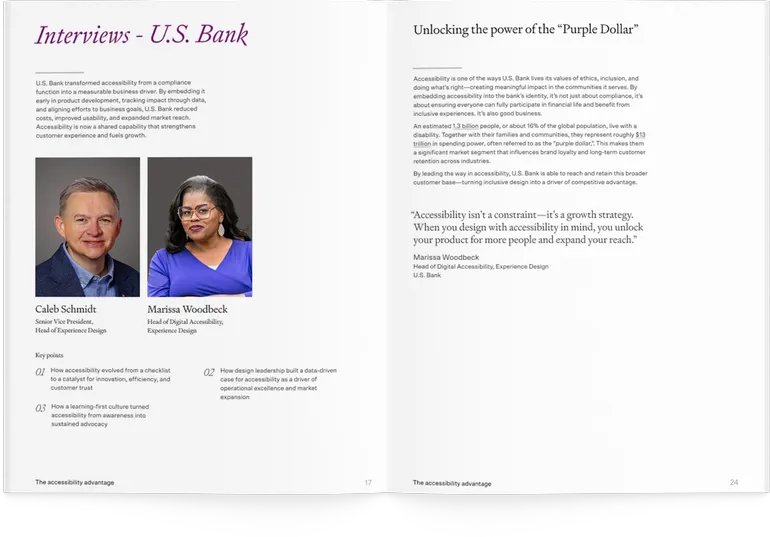
U.S. Bank
Caleb Schmidt & Marissa Woodbeck
Turned accessibility into a measurable business driver — tracking cost-of-fix data and aligning Experience Design OKRs to business priorities to unlock the $13T “purple dollar.”
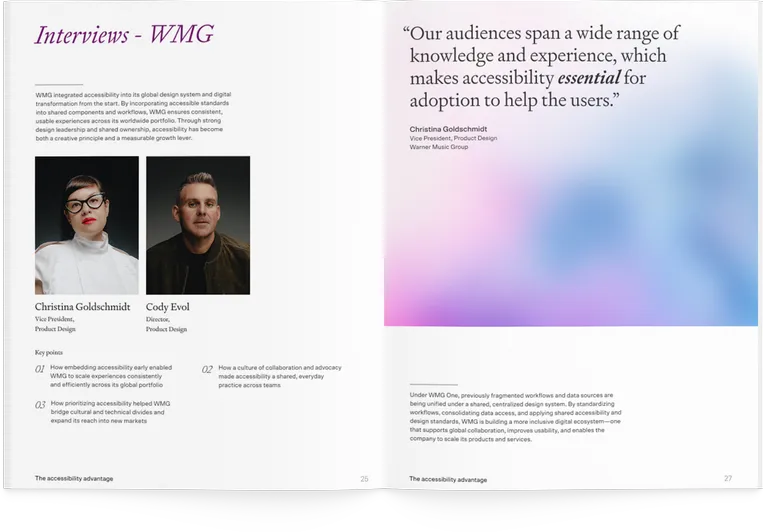
Warner Music Group
Christina Goldschmidt & Cody Evol
Built accessibility into the global design system from the start under WMG One, making it the default across every product team worldwide.
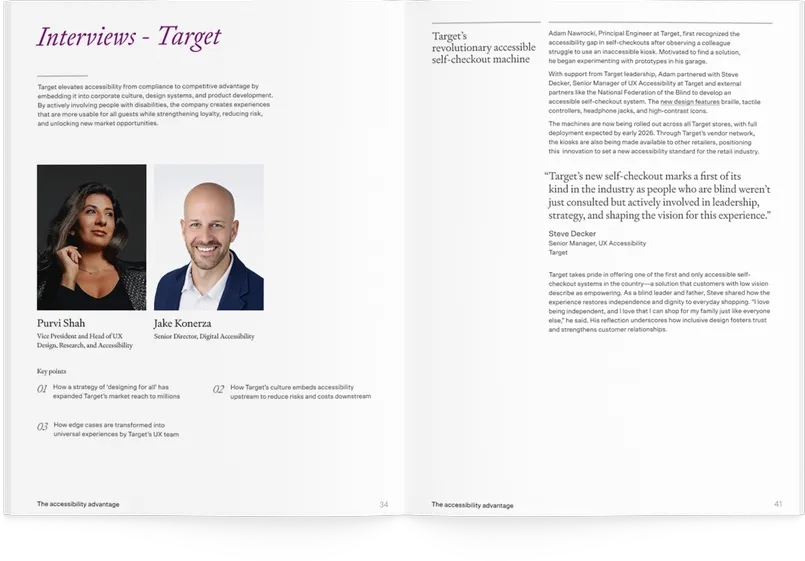
Target
Purvi Shah & Jake Konerza
Reframed accessibility as competitive advantage — involving people with disabilities directly in leadership, including a first-of-its-kind accessible self-checkout.
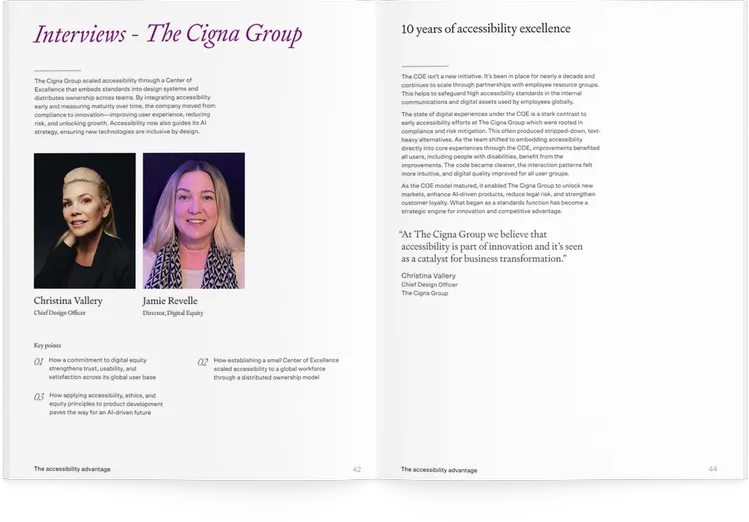
The Cigna Group
Christina Vallery & Jamie Revelle
Scaled accessibility to a global workforce through a Center of Excellence model — a decade in place, embedded across design systems.
Reach and activation
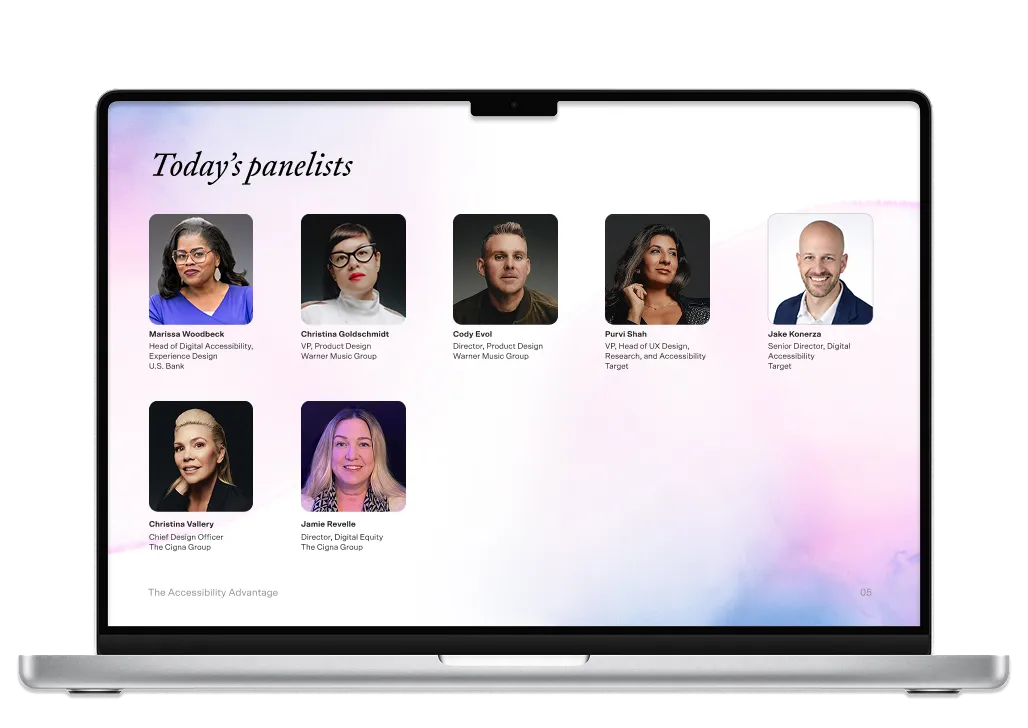
Beyond the report itself, the research became a platform DXC and Fable could activate. The case studies were extended into a public, co-branded panel featuring seven of the eight featured leaders, moderated by DXC's founder and Fable's co-founder.
Webinar registrations
Live attendees
Report downloads
The Accessibility Advantage panel · March 2026
I designed and produced the panel end-to-end, from recruitment and discussion guide through host and speaker prep, and live production.
Reflection
The research caught how programs got funded, how teams scaled, and how mature practices structured ownership. It was less consistent at surfacing customer-facing impact stories. Even with practitioners alongside executives in every conversation, end users with disabilities weren't in the room. The next iteration would build that voice in from the start.
The other thread the work touched but didn't fully resolve was the AI question: not how AI affects accessibility, but what accessibility means when AI agents act on a user's behalf. Jamie Revelle's example of her blind colleague using AI-powered glasses sits in the report as a preview of a question worth its own investigation.
Credits and artifacts
Research and editorial
Neha Paranjpe, Gordon Ching, Neha Shah, Janet Armstrong
Design and production
Gabriel Lam, Krista Pereira
Featured leaders
Caleb Schmidt and Marissa Woodbeck (U.S. Bank), Christina Goldschmidt and Cody Evol (Warner Music Group), Purvi Shah and Jake Konerza (Target), Christina Vallery and Jamie Revelle (The Cigna Group).
Published by
Design Executive Council. Sponsored by Fable.