
DXC × dscout · Case study
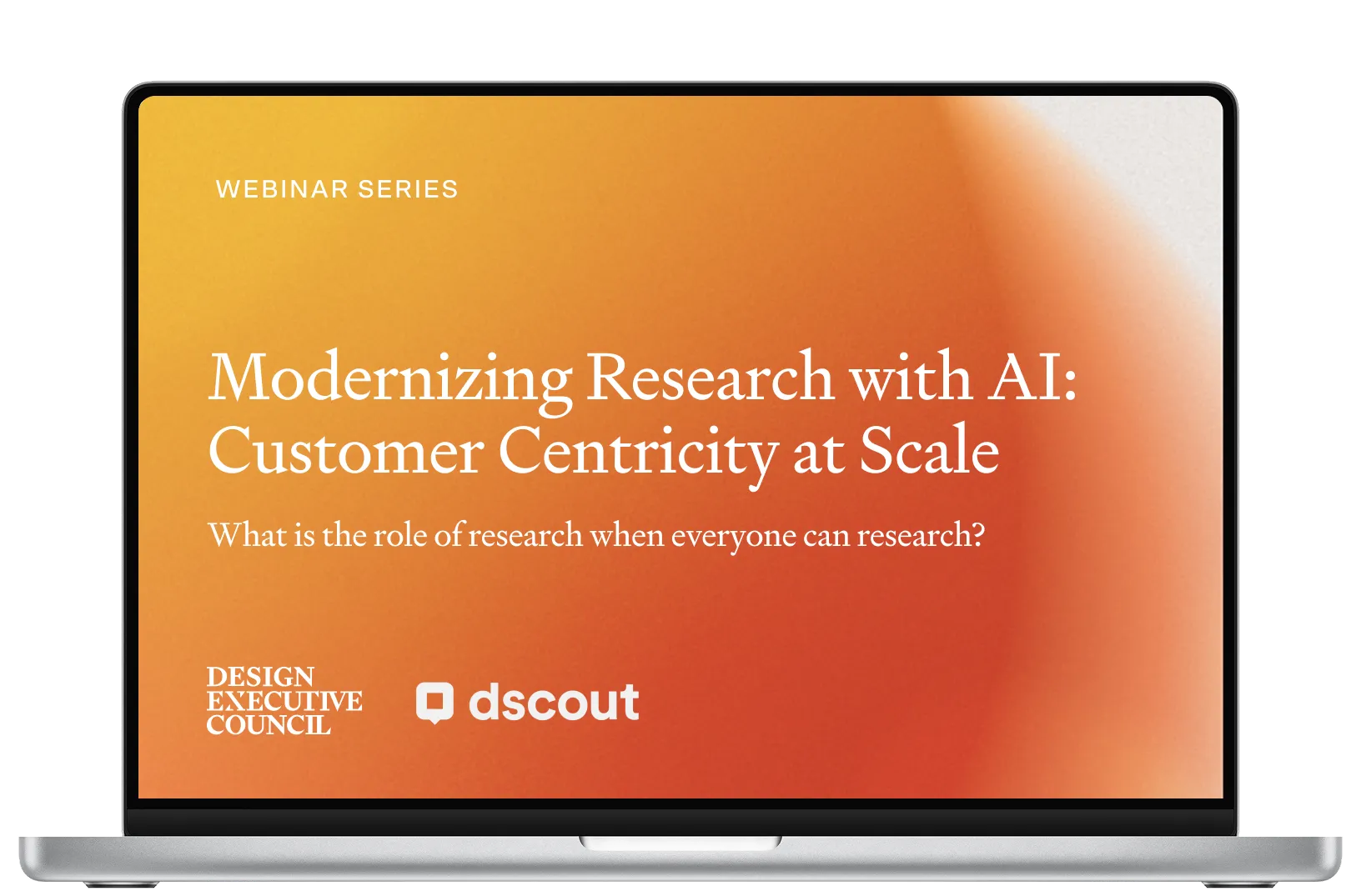
Modernizing research with AI: Customer centricity at scale
What is the role of research teams when everyone can research?
A four-track executive series and micro-paper investigating how senior research and design leaders are rebuilding their teams, workflows, and standards as AI moves into discovery, validation, and evaluation. I developed the inquiry behind each track and co-authored the editorial frame with the DXC founder, Gordon Ching.
Tracks developed into grounded inquiry
Senior leaders convened across the series
Registrations across two completed tracks
Context
The second DXC–Dscout collaboration, building on The AI Shift — a prior report with leaders from JPMorgan Chase, The Cigna Group, AT&T, Amazon, and Sephora. Where that report mapped how AI was reshaping research, this series investigates how leaders are navigating it in practice.
I co-authored the launch article framing the work with DXC founder Gordon Ching.
Read the full articleProblem
Insight only ever traveled as far as the research team could carry it.
For years, research owned customer understanding and carried it into the organization through workshops, decks, and consultations. The model worked — but it capped insight at the reach of a single team.
AI broke that constraint. When anyone can run a study or generate a prototype, the tools that defined the function are no longer exclusive to it. The risk isn't that research disappears — it's that customer-centricity thins out, decision by decision, unless someone owns pushing the ceiling.
Reframe
The floor rises. Someone still has to push the ceiling.
The series reframes the researcher from insight provider to insight architect — the person who builds the systems, sets the standards, trains the agents, and encodes judgment so it reaches every corner of the organization without them needing to be in every room.
The spreadsheet didn't eliminate financial expertise. It redistributed access to it and forced experts to operate at a higher level. AI is doing exactly that to research.
From the launch article I co-authored with Gordon Ching
Approach
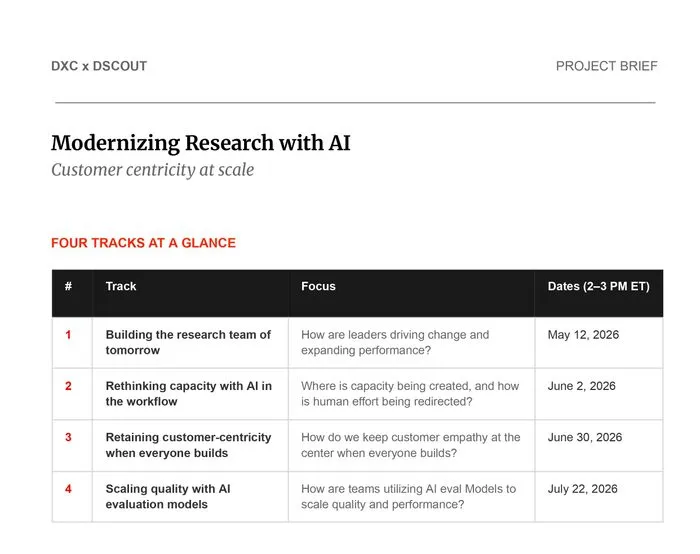
Four broad tracks, developed into grounded lines of questioning.
Gordon Ching and Dscout's Kathleen Hickey set the four tracks in initial strategy workshops. From that frame, I developed each into a grounded line of inquiry — distilling broad topics into specific themes and questions across three segments per track, and building each session's central argument through three to four rounds of revision.
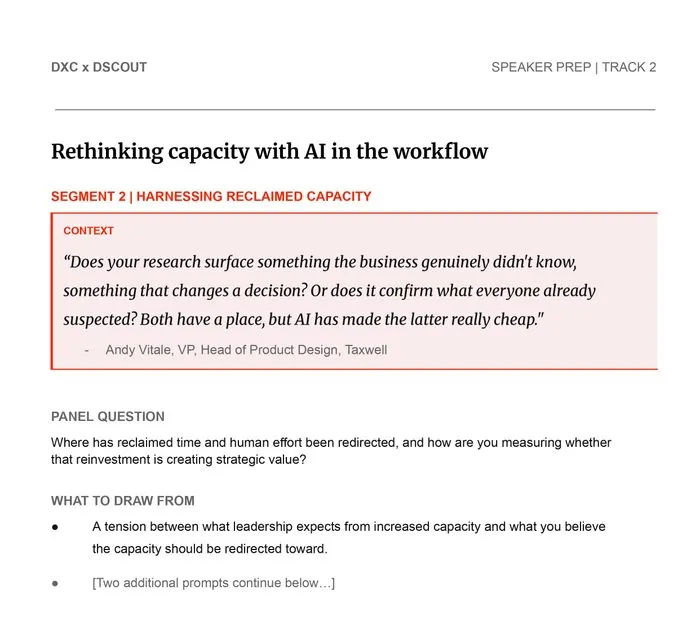
I grounded the deck outlines in evidence, mining our prior research corpus for quotes that aligned to each panel question, and authored speaker prep docs with segment-level prompts to help panelists prepare.
I also wrote the partner and project briefs that served as the source of truth for Dscout and the panelists.
Themes
What the first two conversations surfaced.
Track 1 — Building the research team of tomorrow
Research is evolving from static insights towards intelligent systems of insight.
- 01
Quality of thinking, not task automation. Teams use AI to raise the quality of thinking across the org, not just to work faster.
- 02
Rigor is now the floor. Leaders judge research by whether it surfaced something the business didn't already know.
- 03
Insight lives in systems, not decks. It's built into eval frameworks and knowledge layers teams can query directly.
Track 2 — Rethinking capacity with AI in the workflow
AI isn't simply helping research teams work faster. It is raising their ambition and reshaping where they create value.
- 01
Reclaimed time goes upstream. Toward deeper problem framing and customer understanding that changes strategy, not just confirms it.
- 02
Capacity reinvested in collaboration. From new talent models to faster concept visualization across functions.
- 03
Human accountability is the new skill. As AI amplifies risk and teams no longer control every decision directly.
My role
- 01
Inquiry development. Broad tracks distilled into grounded themes and questions, iterated to approval.
- 02
Evidence grounding. Mining the prior research corpus to anchor each panel question.
- 03
Speaker enablement. Prep docs and segment-level prompts that several panelists called unusually thorough.
- 04
Source-of-truth docs. Partner brief for Dscout, project brief for panelists.
- 05
Series orchestration. Recruitment, dual timelines, demand generation, and live production.
Several panelists consistently flagged the prep docs as unusually thorough and genuinely useful for preparing.
Post-session panelist feedback
Coming up
Two more tracks, then the synthesis.
Track 3 - Retaining customer-centricity when everyone builds
- Rachel Been - SVP of Design, Expedia Group
- Alyssa White - Head of Research, Expedia Group
- Matthew Menz - Former VP of Customer Experience, AWS
- Mary Piontkowski - VP of Product Design, Cisco Networking
- Taylor Klassman - Director of UX, Dscout
Track 4 - Scaling quality with AI evaluation models
- Christina Vallery - Chief Design Officer, The Cigna Group
- Catherine Walker - Head of Content, The Cigna Group
- Michael Winnick - CEO, Dscout
- Anshuman Kumar - SVP, Head of Design, Datadog
- Christian Rohrer - VP of Experience Design, TD Bank Group
The micro-paper
An executive synthesis across all four tracks, launching at Dscout's Co-Lab 2026 conference in October. This section will expand with the synthesis work once the paper is complete.
Reflection
Turning a broad frame into questions worth asking.
The hardest part wasn't running the series — it was developing four broad tracks into questions specific and grounded enough that senior leaders could say something new. Mining prior research to anchor each line of inquiry was where the editorial work really lived.
It surfaces a question the series doesn't resolve: if AI raises the floor on execution, how do organizations keep building the judgment that used to come from doing the hands-on work? That's the tension I'm watching as this work moves toward its synthesis.
Credits and artifacts
Editorial & program lead
Neha Paranjpe
Series framing & strategy
Gordon Ching, Kathleen Hickey
Featured design and research leaders
Andy Vitale - Taxwell
Rylie Heintz - Taxwell
Mary Piontkowski - Cisco Networking
Daniel Avrahami - Cisco Networking
Christian Rohrer - TD Bank Group
Brian Rice - Newell Brands
Richard Dalton - Verizon
Anshuman Kumar - Datadog
Jennifer Darmour - Oracle
Brian Greene - Nationwide
Alyssa White - Expedia Group
Rachel Been - Expedia Group
Dana Cho - Pinterest
Taylor Klassman - Dscout
Michael Winnick - Dscout
Matthew Menz - Amazon Web Services
Christina Vallery - The Cigna Group
Catherine Walker - The Cigna Group
Produced by
Design Executive Council. Sponsored by Dscout.