
DXC × Figma · Case study
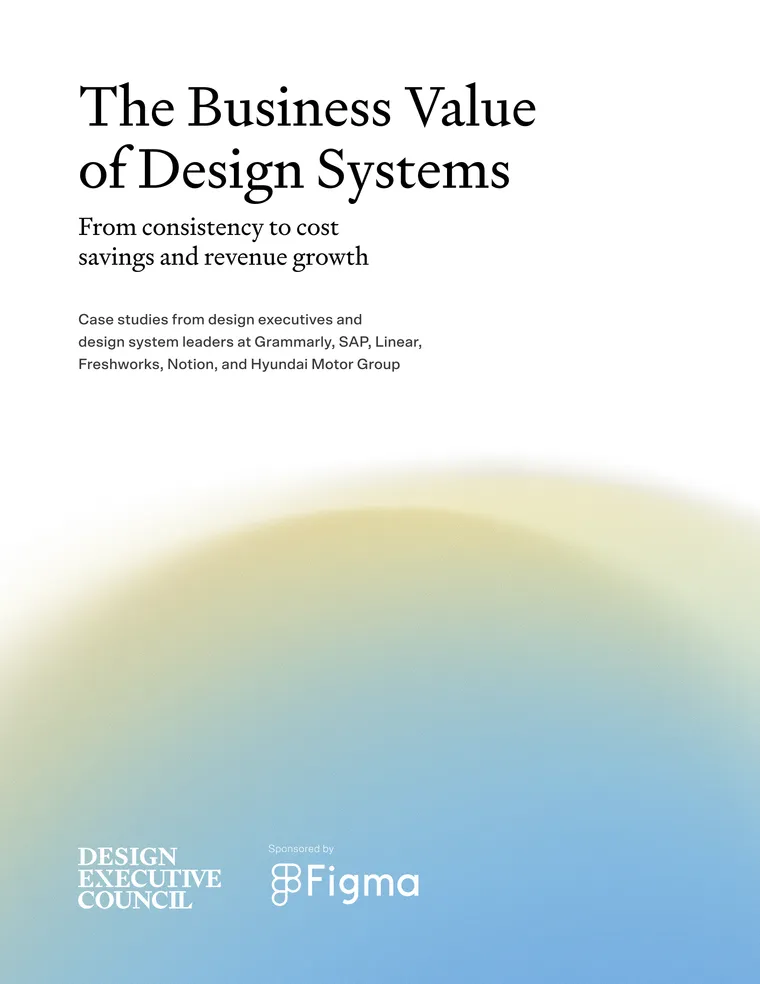
The Business Value of Design Systems
Design leaders know design systems work. The harder problem has been getting the whole organization to invest in them.
An executive report that gave senior design leaders both the board-level language and the patterns for getting the rest of the organization on board, anchored in case studies from Grammarly, SAP, Linear, Freshworks, Notion, and Hyundai Motor Group.
Design leaders profiled, including CDOs, VPs, and the architects building their systems
Global companies, from scale-ups to enterprise
Reactions and 98 reposts on Figma's LinkedIn launch post
Problem
Design systems have been a fixture of senior design conversations for over a decade, but most of that conversation has stayed inside design.
Design leaders know they work. What they've struggled with is making the case for them in language the rest of the organization recognizes and doing it in a way that holds up across regions, company sizes, and maturity stages. Figma commissioned this research to close that gap, with case studies spanning scale-ups to multinationals across the US, Europe, and Asia.
Research questions
The research was anchored in four strategic questions, chosen to push the conversation toward business performance rather than into design practice.
- How are design leaders articulating the value of design systems to business stakeholders?
- What is the relationship between how companies scale efficiently and the role of design systems?
- How do design systems improve customer experiences and revenue growth?
- How is AI impacting investment interest and funding for design systems?
A 60-minute discussion guide translated these into 12 interview questions across five parts: strategic role, business impact, measurement, future needs, and a closing reflection. I wrote and iterated the discussion guide across three rounds. The third revision specifically pressure-tested every question for a non-US audience, responding to the project brief's call-out of US-centricity as a risk in design systems literature.
Approach and engagement
A screener survey filtered an initial pool of candidates against the criteria we'd set with Figma—design leaders running real systems, across maturity stages and regions. We ran a second round of shortlisting when the first didn't hold the mix we wanted, landing on ten leaders across six companies. I ran the outbound layer end-to-end, including the screener, every participant email, headshot collection, and the editorial review cycles that followed each interview.
DXC founder, Gordon Ching ran the 6 interviews, each roughly an hour, with leaders in the US, Europe, and Asia-Pacific. I sat in on every one and took the notes that became the source material for analysis. The analysis itself was manual affinitization, with NotebookLM used selectively for early coding. Across six companies worth of data, I pattern-matched the recurring threads that became the report's findings and recommendation. Gordon and I worked through the framework architecture together.
I authored the full report, shaping the chapter architecture and case study structure alongside Gordon. Each case study was then sent back to its featured leader for approval before publication.
I tracked time and process across the engagement in Asana, which gave us granular cost visibility and accurate margin attribution. The final margin exceeded what the CFO had projected, and the same documentation surfaced a set of process redundancies that I removed in the Fable and Dscout engagements that followed.
Frameworks
The most useful thing the research produced wasn't just transcripts. It was the set of frameworks we developed to make the findings usable by design leaders building their own business cases.
Framework 01
The maturity arc
Core benefits to advanced benefits
Early stage
Efficiency and consistency
Mid stage
Time-to-market and multi-product growth
Late stage
Revenue growth and risk mitigation
From the research
Grammarly's design system, three and a half years in, was reportedly saving design and engineering teams 25% of their work week.
The arc reframes design systems from cost center to strategic infrastructure and gives leaders a way to argue for sustained investment beyond the initial efficiency wins.
Framework 02
The two-lever model
Cost savings and revenue growth
We organized the business value of design systems around the two levers any executive recognizes: margin protection through cost savings, and top-line impact through revenue growth.
Cost lever · Freshworks
Reduced customer service costs and time-to-resolution by 28% by shipping a more consistent product.
Revenue lever · Linear
Net revenue retention climbed from 133% to 171%, attributed to the quality of experience the design system underwrites.
When both levers fire together, design systems begin to show measurable impact on profitability — which is the version executives need to hear.
Framework 03
AI's three levels of impact
Team, business, organizational
Most AI conversations get stuck at the first level - task-level efficiency for designers. We separated that from two more strategic altitudes, both of which depend on the design system as infrastructure.
AI accelerates day-to-day design and development work on top of consistent assets.
SAP's automated compliance checks with AI operating on the standards the design system has already encoded.
Hyundai's ambient AI experiences that has personalized in-vehicle interactions using data and patterns the design system captures.
The framework reframes design systems as the infrastructure that makes AI investments pay off and brings urgency to invest in them in this AI era.
Key takeaway
The three frameworks work together: the maturity arc explains when, the two-lever model explains what, and the AI three-levels framework explains why now.
Reach and activation
Three signals from the report's first months in public.

Figma · 4mo
"Design systems aren't just component libraries anymore, they can drive revenue. New research from the Design Executive Council breaks it down."
Reactions
Reposts
Comments

Webinar by Figma
The Business Value of Design Systems
Featuring senior design leaders from IBM X, Hubspot and Bumble.
January 28, 2026
Watch on demand →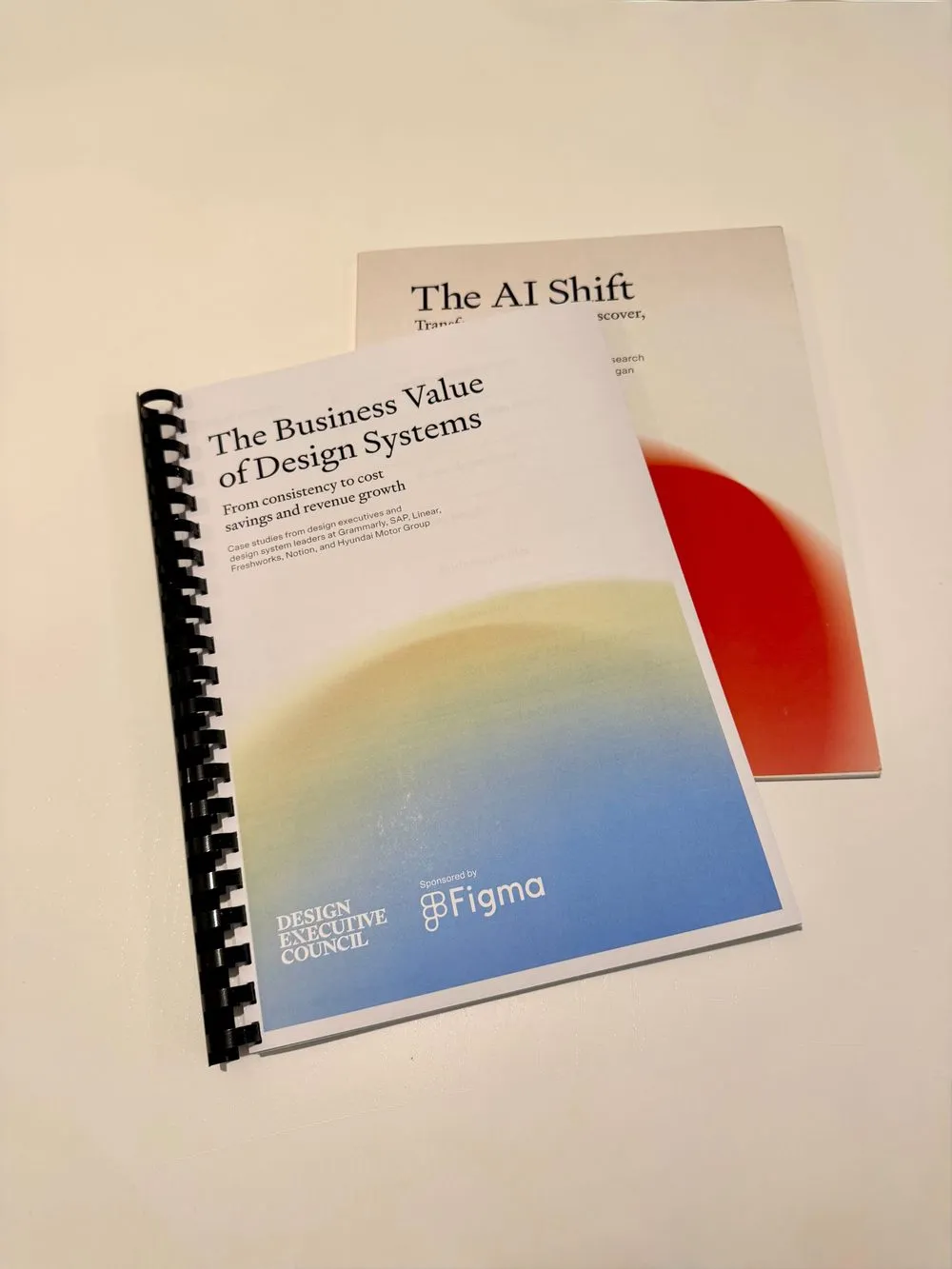
Travel beyond the screen
A reader bound and printed the 72-page report and sent the photograph back. This was the smallest signal in this case study, and one of the most telling.
The report's frameworks became the foundation for a subsequent DXC micropaper on agentic design systems, authored by Gordon.
Inside the report
A snapshot into the 6 case studies from the report.
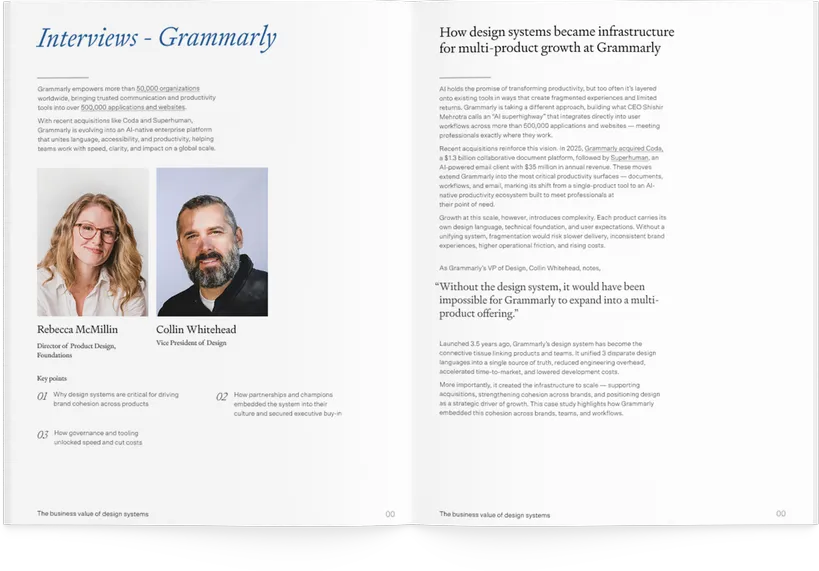
Grammarly
Rebecca McMillin and Collin Whitehead
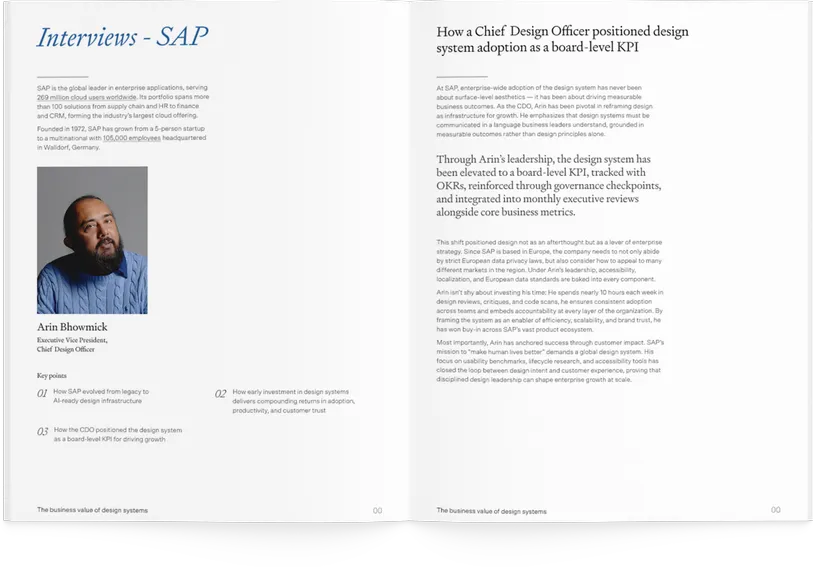
SAP
Arin Bhowmick
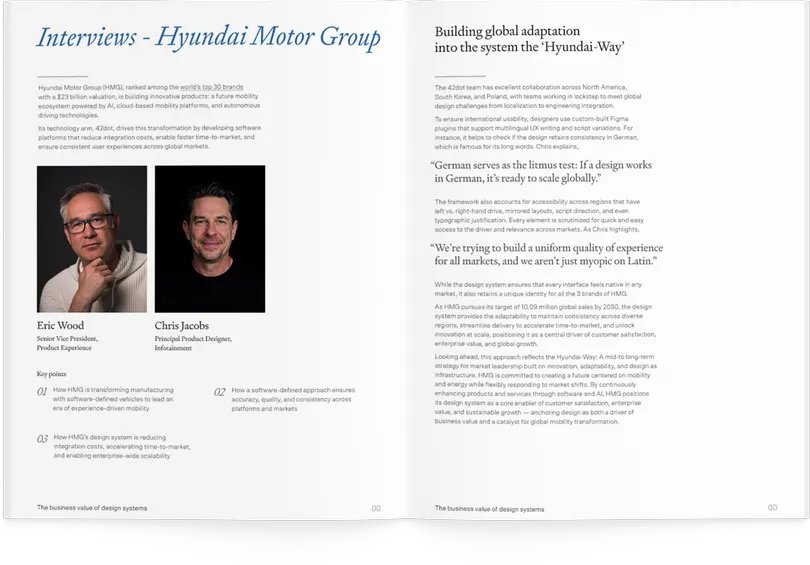
Hyundai Motor Group
Eric Wood and Chris Jacobs
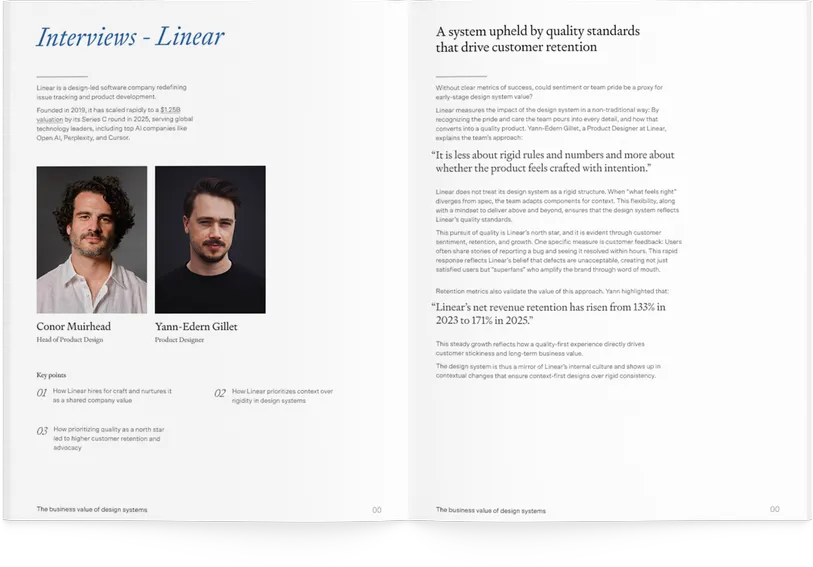
Linear
Conor Muirhead and Yann-Edern Gillet
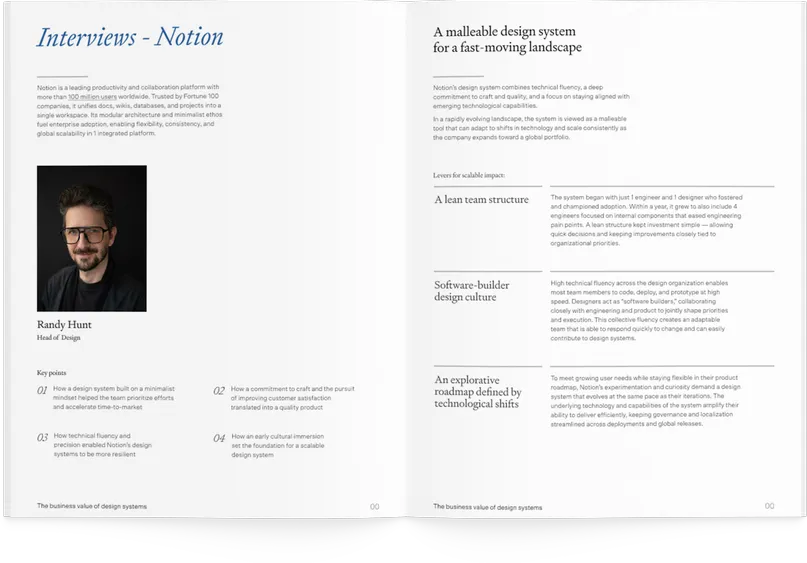
Notion
Randy Hunt
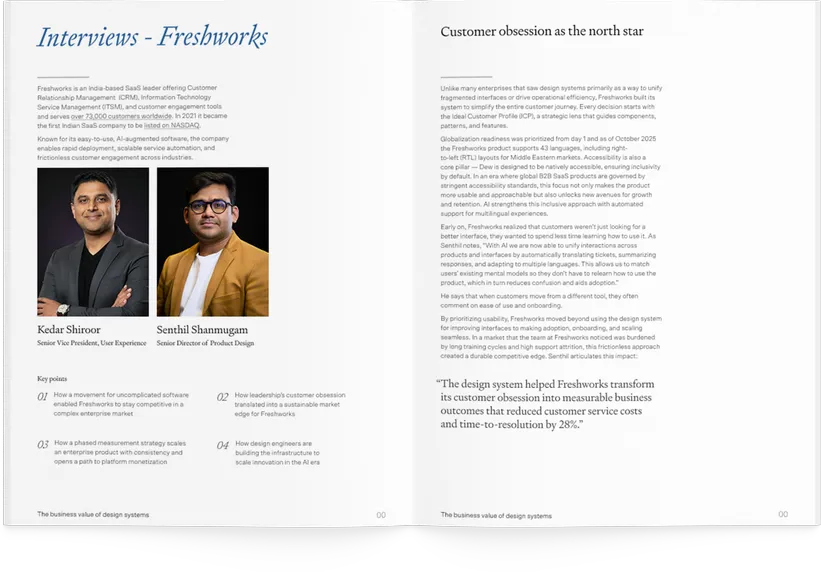
Freshworks
Kedar Shiroor and Senthil Shanmugam
Reflection
What the report could have pushed harderThe report covered AI through one framework — the three levels of impact across team, business, and organizational altitudes. The sharper argument it could have made: design systems are the precondition that lets AI deliver enterprise value.
AI multiplies whatever infrastructure it operates on.
With a mature design system, that multiplication compounds good output. Without one, it accelerates fragmentation at scale.
Gordon and I proposed a follow-on study with Figma to push deeper into this. The conversation didn't move forward at the time. That argument has since become central to how the field talks about design systems and AI — a chapter that wanted to be written.
Where the work changed meThe project shifted how I see research itself. It doesn't only sit downstream of decisions — it can sit upstream, surfacing cost structure, sharpening revenue arguments, and turning process data into operational change. That's the version of research I want to keep building.
Credits and artifacts
Research and editorial
Neha Paranjpe, Gordon Ching, Gabriel Lam, Paul Trotter, Jiayan Yu.
Featured leaders
Rebecca McMillin and Collin Whitehead (Grammarly), Arin Bhowmick (SAP), Conor Muirhead and Yann-Edern Gillet (Linear), Kedar Shiroor and Senthil Shanmugam (Freshworks), Randy Hunt (Notion), Eric Wood and Chris Jacobs (Hyundai Motor Group).
Published by
Design Executive Council. Sponsored by Figma.